Chinese-style metal censer
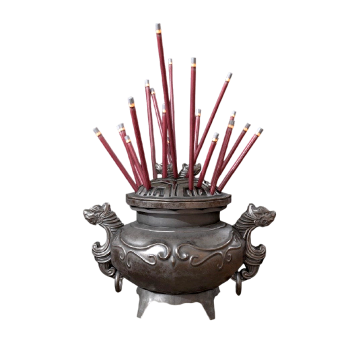
A Chinese-style metal censer used in East Asian cultures primarily for sacrificial rites, religious rituals, or meditation. Used to burn incense sticks (usually the red fine incense shown in the picture, also known as "incense candles") to worship gods or ancestors. It is common in Buddhist and Taoist temples as well as in home places of worship. In traditional Chinese culture, burning incense is a long-standing custom, and the incense burner is an important ritual. Burning the three incense sticks usually represents respecting the three worlds of heaven, the ground and the people, or expressing the highest respect.
Golden incense burner of Jinba culture
"Golden incense burner of Jinbaya culture" is one of the most representative golden religious artifacts of ancient Jinbaya culture in Colombia. It is famous for its exquisite craftsmanship, mysterious decoration and profound religious connotation. The Kimba culture is mainly distributed in the western Andes of Colombia and is one of the earliest civilizations in South America to master complex metallurgical technology. Its name comes from the 19th century Colombian archaeologist's discovery of the "Kimbaya Cemetery", a culture known for its highly developed gold casting, pottery making and agriculture.
Antique dragon incense burner
With its exquisite carvings and unique dragon patterns, it has become a treasure in traditional Chinese art. It is not only a work of art, but also an important manifestation of dragon totem worship in Chinese culture. The history can be traced back to the Han Dynasty. As a symbol of the Chinese nation, the dragon pattern has profound cultural significance. Features include the unique dragon pattern decoration, the image of the dragon is usually presented as a cloud of fog, posture, carving lifelike, meticulous. The production process is complex and requires multiple processes to show a high artistic level. In history, the dragon incense burner is not only a practical instrument, but also an important tool for etiquette and sacrifice.
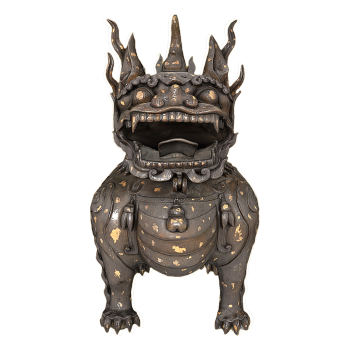
Bronze Lion Incense Burner in Qing Dynasty Temples
The "Bronze Lion Incense Burner in Qing Dynasty Temple" is a pair of 17th century Chinese cultural relics, currently collected at the Minneapolis Museum of Art in the United States. This lion shaped incense burner is a guard lion, and each of these auspicious beasts (Lin) has a unicorn. They are mythical animals endowed with the ability to distinguish between good and evil. These legendary animals appear in pairs and are used to stand on both sides of the imperial throne in the Forbidden City, representing the dignity, virtues, and wisdom of the royal family.
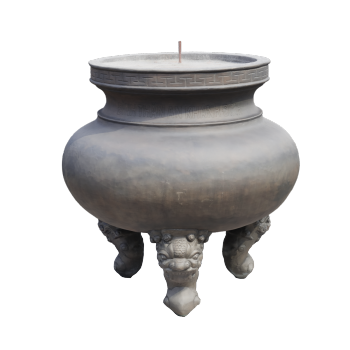
Jingtai Blue Ding Incense Burner Qing Qianlong Copper Body Cloisonn é Enamel Square Ding Incense Burner
Old bronze vessels, copper incense burners, incense burners, Buddhist utensils, three legged auspicious beasts, bronze tripods
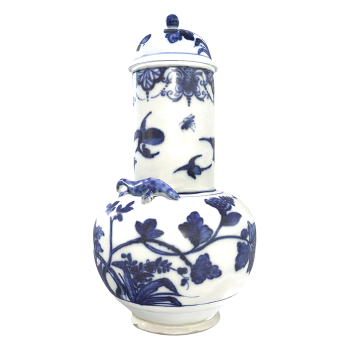
The "Cloisonn é Incense Burner" produced during the Kangxi period of the Qing Dynasty
This Chinese cultural relic is a type of incense burner, belonging to the category of metal handicrafts. It was made by craftsmen in Jingdezhen and is part of a set of altar equipment, using cloisonn é craftsmanship. This artifact is currently located on the staircase of Gallery 17 at the Fitzwilliam Museum, University of Cambridge. This artifact was donated by John McClane. It was made around the 18th century, specifically during the Kangxi period.
Bronze ware from the Six Dynasties period, 'Six Dynasties Bronze Chicken shaped Incense Burner'
This cultural relic is a bronze vessel called "Censer, bird shaped", which was created during the Six Dynasties period in China (220-589 AD). This incense burner is currently housed in the British Museum. The shape of this incense burner is a rooster with a chick. It is made of bronze and the size of this incense burner is 6 inches in height.
Bronze incense burners during the Qianlong period
This incense burner was commissioned by Emperor Qianlong and bears the words' Made in the Qianlong Year of the Qing Dynasty ', possibly originating from a magnificent royal temple. Approximately 14 centimeters in height and 26.7 centimeters in diameter. This incense burner is a cultural relic from the Qianlong period of the Qing Dynasty (1736-95). Now it is collected in the British Museum.
Bronze censer in the Western Han Dynasty
This artifact is an incense burner with geometric decoration and narrative scenes. It is made of bronze and inlaid with gold, silver, turquoise and onyx. The dimensions are 17.9cm high and 10cm wide. The artwork may have originated in Henan or Hebei province. The date of production is about the 2nd century BC and belongs to the early Western Han Dynasty. The work is now in the collections of the Freer Gallery and the Arthur M. Sackler Gallery.
Popular Models
Shrine
115 View
King Kong Hercules Wood Carving
166 View
The bell tower of a Japanese temple
189 View
Japanese Samurai Helmet
117 View
Random Model
Four-wheel skates (roller skates)
136 View
Pure milk box 500ml
292 View
Thor Off-Road Motorcycle Boots
140 View
Platypus 3D Model Animation
124 View
SP Crater Crater, Arizona
241 View
Adidas Racer TR21 sneaker
150 View
Metal cutting scissors
360 View
Shawneemidburg, UK
268 View